arrow_back Back to all resources

Dignified Access: Designing an accessible workplace

What is Dignified Access in the Workplace?

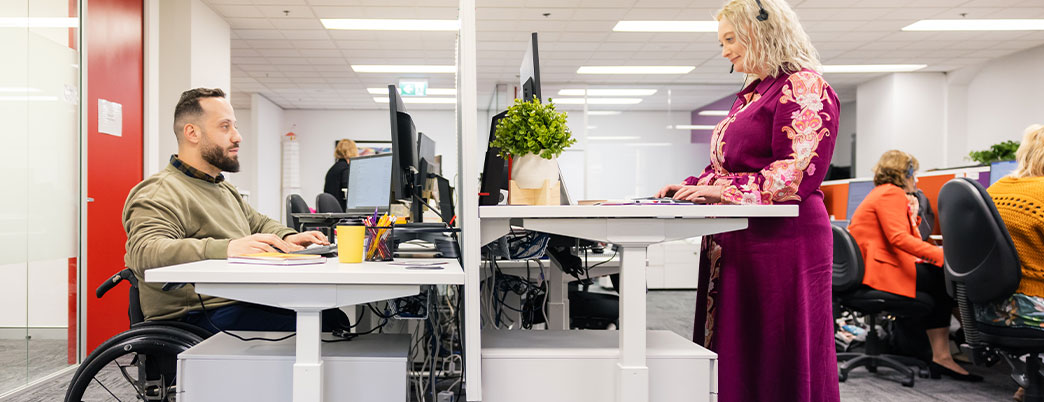
Dignified Access is about moving beyond building compliance to reflect a commitment to a dignified experience when interacting with any space or place.  Dignified Access should be available for all employees, visitors, and clients. Everyone should be able to access the premises in a dignified way.

Dignified Access means:

  • Participation of people experiencing a disability as a natural and expected thing
  • A place where people feel at-ease, safe and connected.
  • More independent access to premises, goods, and services.
  • Equitable or fair access.

Creating a safe, inclusive, and empowering environment benefits everyone, including people with disability

00:00:00:00 – 00:00:20:10
Tom
Come with me on a Dignified Access Tour of this building. Let’s go. So we’re here at 595 Collins. And the first thing is, how do we know that we’re in the right spot? And thankfully there’s some really good signage. Big, bold numbers, good contrast. So we can see that we’re in the right place, which is great.

00:00:20:13 – 00:00:40:13
Tom
But we’ve got other things to contend with as well. So we’ve got lots of pedestrians, we’ve got traffic, we’ve got trams, noise, even smells from cafes. So being aware of those as barriers or potential barriers will help someone with their access if they have those needs. So we need to know what those barriers are. Now that we’re in the right building, we’ve got the right address.

00:00:40:13 – 00:00:59:03
Tom
We know where we are. The next task is to actually get into the building. So what we’re looking for is an accessible path of travel. We’ve got revolving doors here, and that’s not a good option or a good choice. If we need an accessible door, we need to be able to find it. There are two here, one just right in front of us, which we actually can’t see because there’s no signage.

00:00:59:03 – 00:01:17:23
Tom
There’s no wayfinding to say, hey, if you need to get in an accessible entrance, come this way. We just need to have some signs up here which would really help. And to get in, this is brilliant, you don’t need to touch anything, you just wave and the door opens. And that’s awesome.

00:01:18:00 – 00:01:36:09
Tom
Okay, so we’re in the building now. We’re in the right place. We’ve got to find the floor that we need to get to. And the lobby is a really important part of our journey to work. You can imagine. Maybe you’ve rushed here, you’re feeling tired. You’re feeling stressed. The lobby is a good place to kind of regulate. This one’s big, which means there’s great circulation.

00:01:36:11 – 00:01:53:07
Tom
The air conditioning, it’s a hot day outside. The temperature is really good as well, so that’s calming. And it’s not too busy or noisy at the minute. You need to consider this because that can change as well. So we’re looking for things like is there a place to sit. Do they have arms for mobility support? And is the contrasting good?

00:01:53:07 – 00:02:09:09
Tom
And in this lobby we’ve got great options and choices for that. One of the most important and helpful things in the lobby as well is the directory. And so here we’ve got a really nice big directory, digital screen, and we can see if we’re going to floor 14 for Yooralla, we know we’re in the right place and we can actually see it.

00:02:09:09 – 00:02:27:01
Tom
So we know where we’re going to. Again, we’ve got some really great wayfinding signage. So you couldn’t get bigger and bolder than this. And black on the gray is great. It’s got some lighting too so it really stands out. So from here we’re going to find the lifts. Okay so wayfinding again is an incredibly important part of access.

00:02:27:01 – 00:02:43:17
Tom
And here we’ve trying to get to the lifts, trying to find the right lift, sometimes that is really challenging. But we’ve got great signage again. And most importantly the contrast is perfect. So if we’re looking for lift or level 14, I know that I need to go this way and I immediately feel comfortable and know where I’m going.

00:02:43:20 – 00:02:57:23
Tom
Thank you for coming along on a Dignified Access Tour with us. We’ve just shown you a glimpse of some of the things that we can look at and support you in making your premises more accessible. So if you want to find out more about Dignified Access, more about what work we do here at Australian Disability Network, get in touch.

00:02:57:23 – 00:03:07:17
Tom
And we’re here to help you and support you make our workplaces more accessible for everyone.

Download the transcript (TXT, 4KB)

Our Dignified Access Services: How we can support you

Dignified Access Review

Delivering a thorough physical review of your premises, with a clear, actionable report to help you create spaces that are accessible, inclusive, and welcoming.

Dignified Access Desktop Review

Evaluating your plans, fit out designs, concept drawings and renders, offering practical recommendations to embed accessibility and inclusion from the start.

Dignified Access Walkthrough

Come along with us as we navigate your workplace, supporting you to identify opportunities to enhance your premises and create a dignified experience for all employees. Our consultants guide you in creating spaces that work for everyone.

Dignified Access Training

Builds awareness and skills to support inclusion. Offered in person, online, or hybrid, these sessions are full of practical ways to apply dignified access at work.

Why is Dignified Access needed when we have the Australian Standards?

Australian Standards are for ensuring buildings and facilities are accessible to people with disability, however they have some limitations:

  • Australian Standards set only the minimum.
  • Standards are modelled on data from people aged 18 – 60, excluding younger and older people.
  • Most measurements are based on data from 1983.
  • Current mobility technology and wheelchair innovations aren’t considered.
  • Australian Standards overlook non-visible disability, which account for a significant proportion of all disability.
  • Dignified Access doesn’t replace the Building Code of Australia or Standards; it guides ‘beyond compliance’ principles to make spaces more accessible, dignified, and equitable.

Contact us to find out more

To find out more about Dignified Access and the services we provide, please contact us at Tom.Bevan@AusDN.org.au or call +61 3 7032 3529

Your shopping cart

No products in the cart.

Go to Shop